Jump to Content
Construction Chemicals Market - Size, Share, Industry Trends, and Forecasts (2024 - 2031)
Construction Chemicals Market Size:
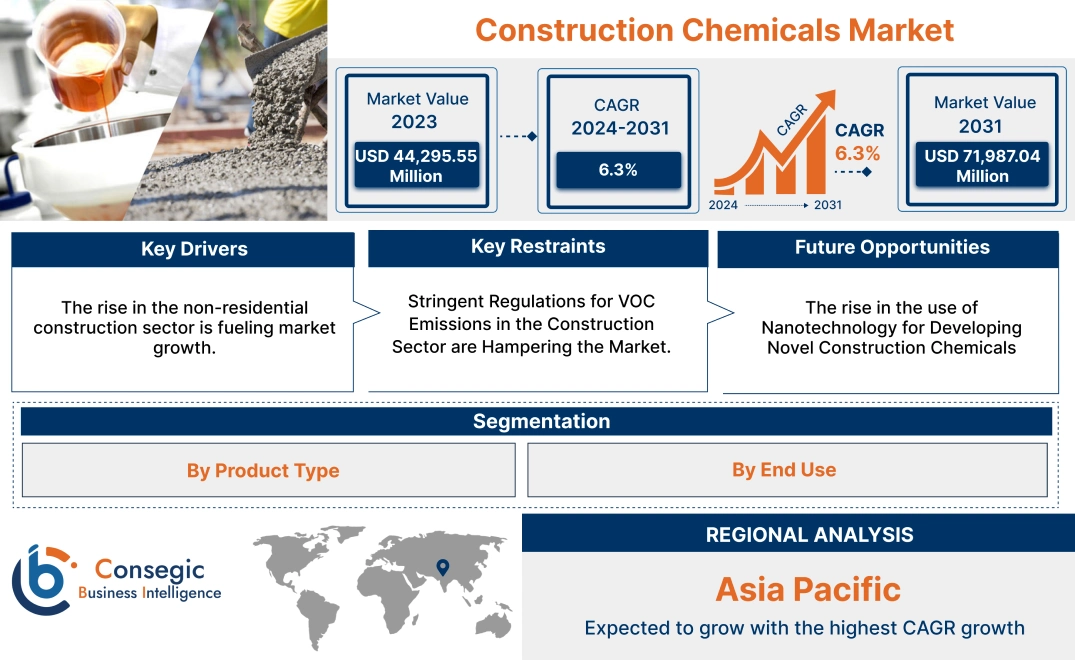
Construction Chemicals Market size is growing with a CAGR of 6.3% during the forecast period (2024-2031), and the market is projected to be valued at USD 71,987.04 Million by 2031 from USD 44,295.55 Million in 2023.
Construction Chemicals Market Scope & Overview:
Construction chemicals are specialized chemical products used to enhance the properties of construction materials and improve the overall performance of structures. These chemicals are used in various stages of construction, from foundation laying to finishing. They include products like concrete admixtures, waterproofing agents, sealants, adhesives, protective coatings, and others. These chemicals help to improve the strength, durability, and water resistance of concrete, enhance the bonding properties of materials, and protect structures from weathering and corrosion. As per the analysis, these chemicals are widely used in various residential, commercial, industrial, and infrastructural construction projects.
How is AI Transforming the Construction Chemicals Market?
AI-powered algorithms analyze vast datasets, simulate chemical reactions, and predict material properties, significantly reducing the time and cost associated with developing new chemicals and materials. Additionally, AI analyzes real-time sensor data from machinery to predict potential failures, allowing for scheduled maintenance and reducing downtime, repair costs, and safety risks. Moreover, AI can optimize chemical formulations by predicting the best combinations of ingredients for specific properties, considering factors like performance, cost, and environmental impact.
Construction Chemicals Market Dynamics - (DRO) :
Key Drivers:
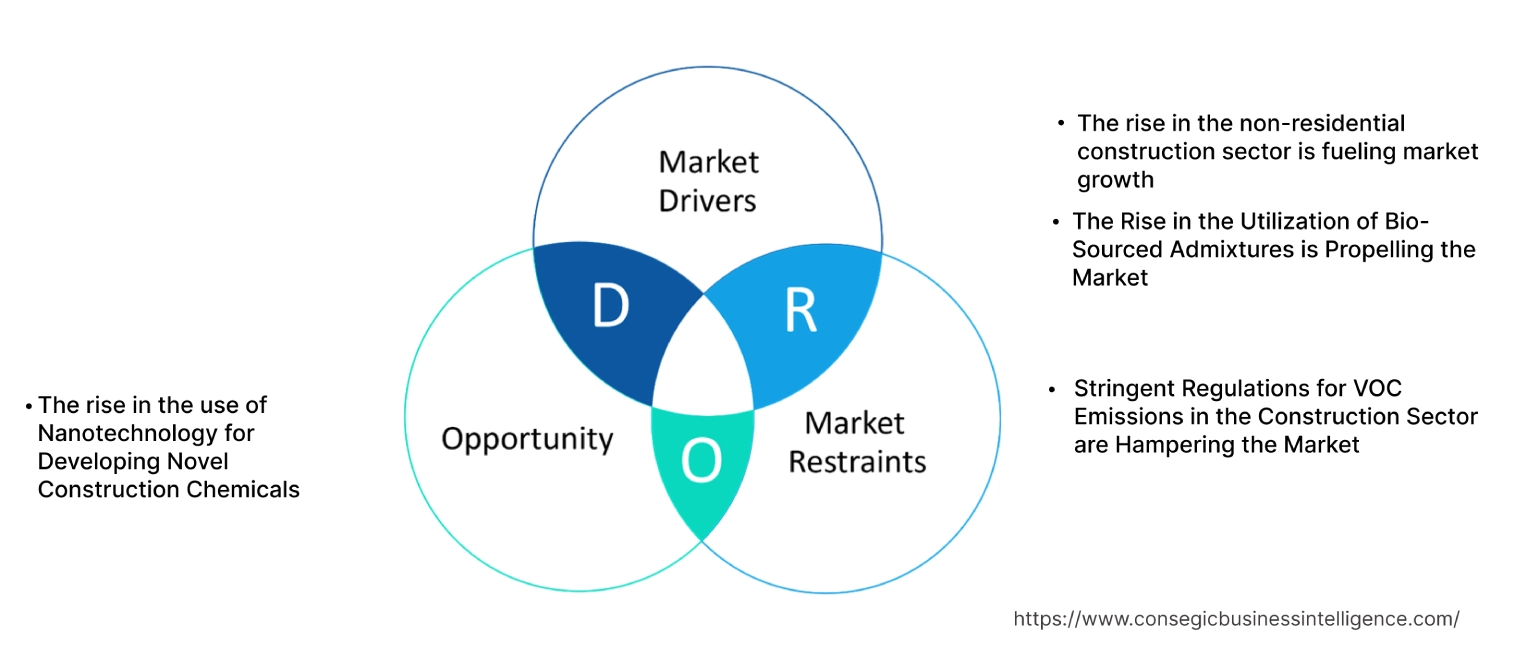
The rise in the non-residential construction sector is fueling market growth.
The global construction chemicals market is experiencing robust growth, fueled by the increasing requirement for efficient and sustainable construction solutions for non-residential settings. As non-residential buildings and construction proliferate worldwide, the need for high-performance chemicals is surging. These chemicals play a vital role in the non-residential sector, contributing to the construction of durable, sustainable, and aesthetically pleasing buildings. By incorporating these chemicals, non-residential buildings achieve higher levels of durability, fire resistance, and energy efficiency.
By improving the properties of construction materials, these chemicals contribute to the development of more resilient and long-lasting non-residential structures. As the construction sector continues to evolve, the demand for innovative and eco-friendly chemicals is expected to remain strong, driving market growth. Based on the analysis, these factors are influencing the rise in the construction sector.
- For instance, According to the article published by Invest India, the robust growth of India's construction sector which includes non-residential construction, is projected to reach USD 738.5 billion by 2022 at a CAGR of 15.7%, is a significant driver for the construction chemicals market. This surge in construction activity, encompassing infrastructure development, commercial projects, and industrial facilities, is fueling the demand for high-performance chemicals.
Thus, the market is experiencing robust growth, driven by the increasing demand for efficient and sustainable construction solutions. As non-residential projects proliferate worldwide, the need for high-performance chemicals is surging.
The Rise in the Utilization of Bio-Sourced Admixtures is Propelling the Market
The construction sector is increasingly utilizing sustainable practices, and bio-sourced admixtures are emerging as a promising solution. These admixtures, derived from renewable biological sources like bacteria, fungi, and plants, offer numerous advantages over traditional chemical-based products. Bio-sourced admixtures enhance concrete's strength, durability, and water resistance while reducing its carbon footprint.
They also contribute to improved air quality and reduced energy consumption during construction. As the demand for sustainable building materials grows, the utilization of bio-sourced admixtures is gaining significant momentum, driving the development of greener and more resilient infrastructure. Various manufacturers are introducing products that are derived from biological sources.
- For instance, in 2023, Chemex introduced a range of bio-sourced admixtures that are designed for a lower carbon footprint, which is 70% lower than traditional oil-based admixtures. The products include ISOFLEX BIO which is concrete plasticizers and superplasticizers that reduce carbon and water use by up to 20-30%.
Thus, as the demand for sustainable building materials continues to rise, the adoption of bio-sourced admixtures is expected to accelerate, driving the development of greener and more resilient infrastructure.
Key Restraints :
Stringent Regulations for VOC Emissions in the Construction Sector are Hampering the Market.
Stringent regulations aimed at reducing Volatile Organic Compound (VOC) emissions in the construction sector are posing limiting factors to construction chemicals market growth. Some chemicals such as adhesives, sealants, and coating among others are responsible for VOC emissions. Regulations, while necessary for environmental protection, increase production costs and limit the availability of certain chemicals. Manufacturers are compelled to reformulate their products to comply with these regulations, which are time-consuming and expensive processes.
Additionally, the increased examination of VOC emissions led to delays in product approvals and market entry. While these regulations are essential for safeguarding public health and the environment, they also hinder innovation and limit the development of new, high-performance chemicals. Thus, stringent regulations are hindering construction chemicals market demand.
Future Opportunities :
The rise in the use of Nanotechnology for Developing Novel Construction Chemicals
Nanotechnology is emerging as a novel method in the construction industry, offering innovative solutions for developing novel chemicals. By manipulating matter at the nanoscale, materials with extraordinary properties, such as increased strength, durability, and water resistance are developed. The incorporation of nanomaterials into these chemicals has led to the development of self-healing concrete, superhydrophobic coatings, and highly efficient thermal insulation materials.
These advancements not only improve the performance and longevity of structures but also contribute to sustainable construction practices. As nanotechnology continues to evolve, it is poised to develop the construction sector, leading to the development of even more innovative and sustainable chemicals. Manufacturers are introducing novel solutions that offer enhanced properties for construction applications.
- For instance, in April 2024, Gerdau Graphene, a leading nanotechnology company, introduced a novel line of graphene-based admixtures, known as NanoCONS, specifically designed for the construction sector. This innovative product line leverages the exceptional properties of graphene, a two-dimensional carbon nanomaterial, to significantly enhance the performance of concrete.
Overall, Nanotechnology is reshaping the construction sector by enabling the development of innovative and high-performance chemicals, thus influencing the construction chemicals market opportunities.
Construction Chemicals Market Segmental Analysis :
By Product Type:
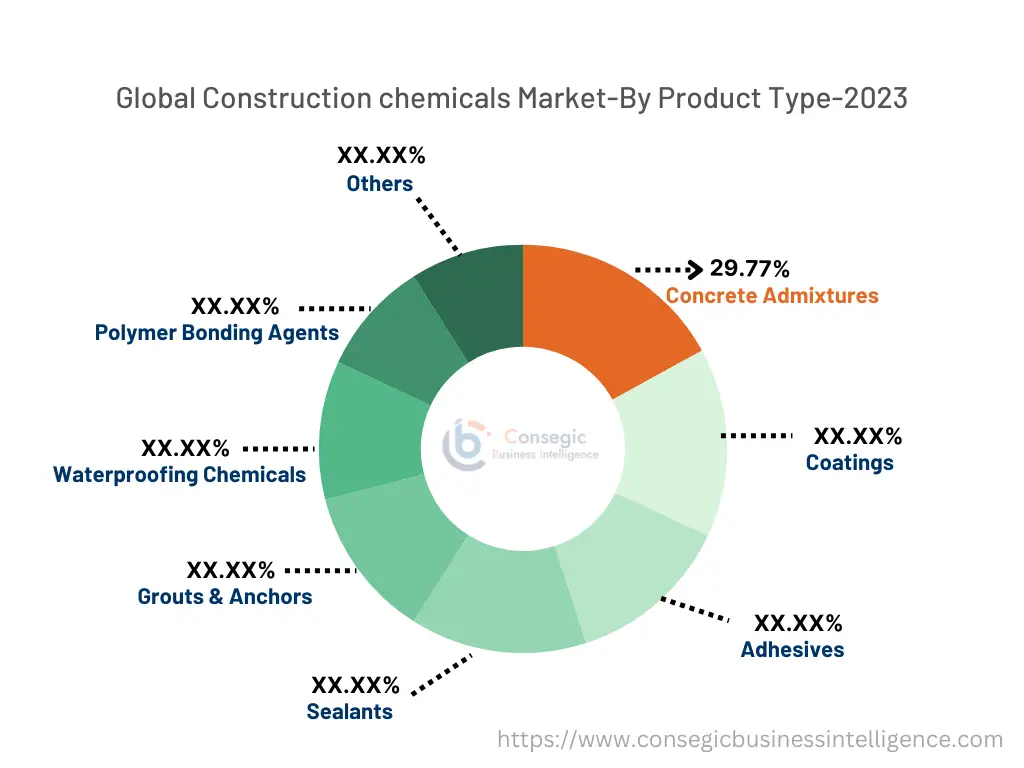
Based on product type, the market is segmented into Concrete Admixtures, Coatings, Adhesives, Sealants, Grouts & Anchors, Waterproofing Chemicals, Polymer Bonding Agents, and others.
Trends in the product type:
- There is a rise in trends for bio-sourced admixtures as they offer sustainable solutions.
- As per the analysis, rising trends for innovative solutions that repair microcracks in concrete, extending its lifespan and reducing maintenance costs
The concrete admixtures segment accounted for the largest construction chemicals market share of 29.77% in 2023
- Concrete admixtures are chemical substances added to concrete to modify its properties. These additives enhance various characteristics of concrete, such as its strength, workability, durability, and setting time.
- Common types of concrete admixtures include water reducers, air-entraining agents, accelerators, retarders, superplasticizers, and others.
- Water reducers reduce the amount of water needed for mixing, leading to higher strength and durability.
- Air-entraining agents introduce microscopic air bubbles into the concrete, improving its resistance to freeze-thaw cycles.
- Accelerators and retarders control the setting time of concrete, allowing for flexibility in construction schedules.
- Superplasticizers significantly increase the workability of concrete, enabling the production of high-performance concrete with minimal water content.
- Various manufacturers are introducing novel concrete admixtures that offer advanced properties.
- For instance, in 2023, Master Builders Solutions UK Ltd introduced a high-range water-reducing admixture for concrete. MasterGlenium 399, is a high-performance water-reducing admixture specifically designed for dry silo systems. This unique blend of modified polycarboxylic ether superplasticizers enhances concrete properties, optimizing its performance and efficiency.
- Thus, the rise in the use of concrete admixtures is driving trends for the segment.
The waterproofing chemical segment is expected to grow at the fastest CAGR over the forecast period.
- Waterproofing chemicals are essential components in modern construction, safeguarding structures from water damage and ensuring their longevity.
- These chemical compounds are applied to various surfaces like roofs, basements, terraces, and walls to create a protective barrier against water ingress.
- Common types of waterproofing chemicals include polyurethane coatings, acrylic coatings, bituminous membranes, and crystalline waterproofing agents.
- Various novel products are introduced which consist of waterproofing chemicals.
- For instance, in 2024, Shalimar Paints introduced Zero Damp elastomeric waterproof coating, which is a fiber-reinforced solution that provides robust protection against both internal and external water seepage.
- As per the analysis, by effectively preventing water penetration, waterproofing chemicals help maintain the structural integrity of buildings, minimizing costly repairs and ensuring a comfortable and durable living or working environment, thus influencing the construction chemicals market expansion and trends in coming years.
By End-Use:
Based on End Use, the market is categorized into residential construction, commercial construction, industrial construction, and infrastructural construction.
Trends in the end-user:
- There is a growing trend towards eco-friendly and sustainable construction materials, including bio-based and recycled materials for the construction of various commercial projects.
- Prefabricated construction methods are gaining popularity, requiring specialized adhesives, sealants, and other chemicals for efficient assembly and durability.
The residential construction segment accounted for the largest construction chemicals market share in 2023.
- Residential construction is the process of building, renovating, or expanding homes and other living spaces. This includes everything from single-family homes to large apartment complexes.
- Construction chemicals play a vital role in enhancing the durability, strength, and water resistance of these residential constructions. These chemicals are used in various stages of construction, including foundation laying, wall and floor construction, waterproofing, and finishing.
- Concrete admixtures improve the workability and strength of concrete used in foundations and structural elements. Waterproofing chemicals protect structures from water damage, ensuring their longevity. Sealants and adhesives provide watertight seals and strong bonds between different materials.
- By incorporating these chemicals, durable, resilient, and energy-efficient residential buildings are developed.
- The rise in the construction of new residential buildings leads to the utilization of these chemicals in various applications.
- For instance, according to a joint announcement by the U.S. Census Bureau and the U.S. Department of Housing and Urban Development, approximately 1.31 million new housing units were started and 1.61 million were completed in 2024. This influences the use of construction chemicals incorporated in these housing units
- Thus, the rise in residential construction is driving the construction chemicals market demand.
The infrastructural construction segment is expected to grow at the fastest CAGR over the forecast period.
- Infrastructural construction encompasses a wide range of projects, including roads, bridges, dams, tunnels, and airports.
- Construction chemicals play a critical role in enhancing the durability, strength, and longevity of these infrastructure projects. These chemicals are used in various applications, such as concrete to improve the workability and strength of concrete, waterproofing agents to protect structures from water damage, and corrosion inhibitors to prevent the deterioration of steel reinforcement.
- By employing these chemicals, engineers build robust and resilient infrastructure that withstand harsh weather conditions and heavy loads.
- These chemicals contribute to the overall safety, efficiency, and sustainability of infrastructure projects, thus driving the segment leading to construction chemicals market opportunities.
Regional Analysis:
The regions covered are North America, Europe, Asia Pacific, the Middle East and Africa, and Latin America.
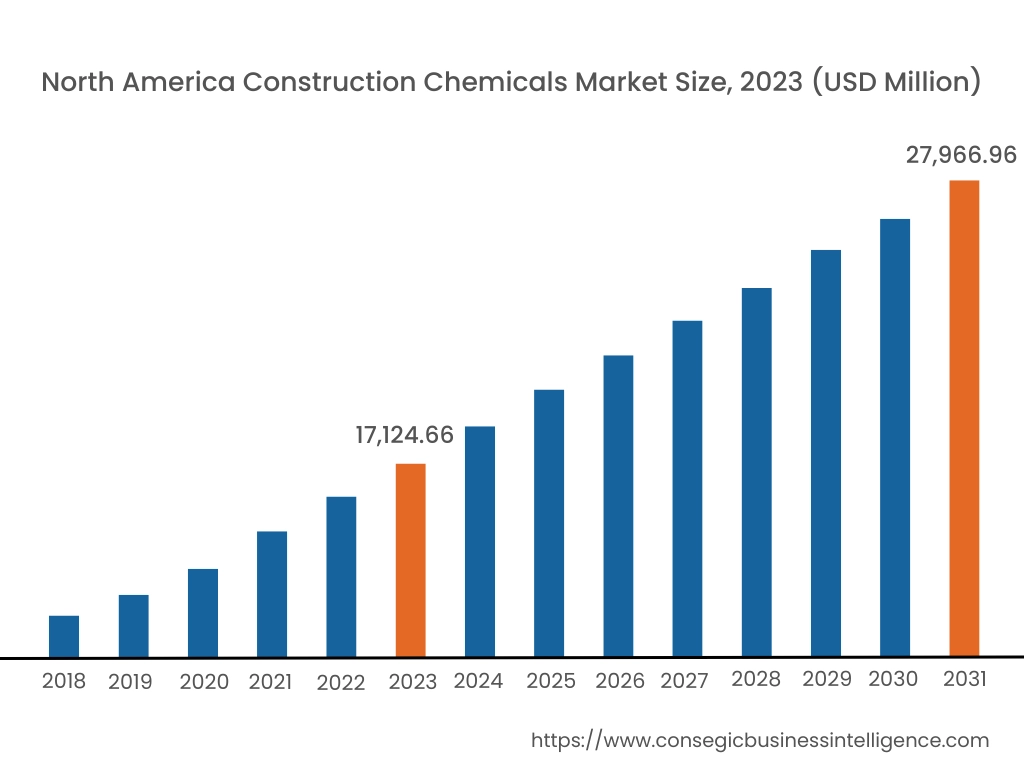
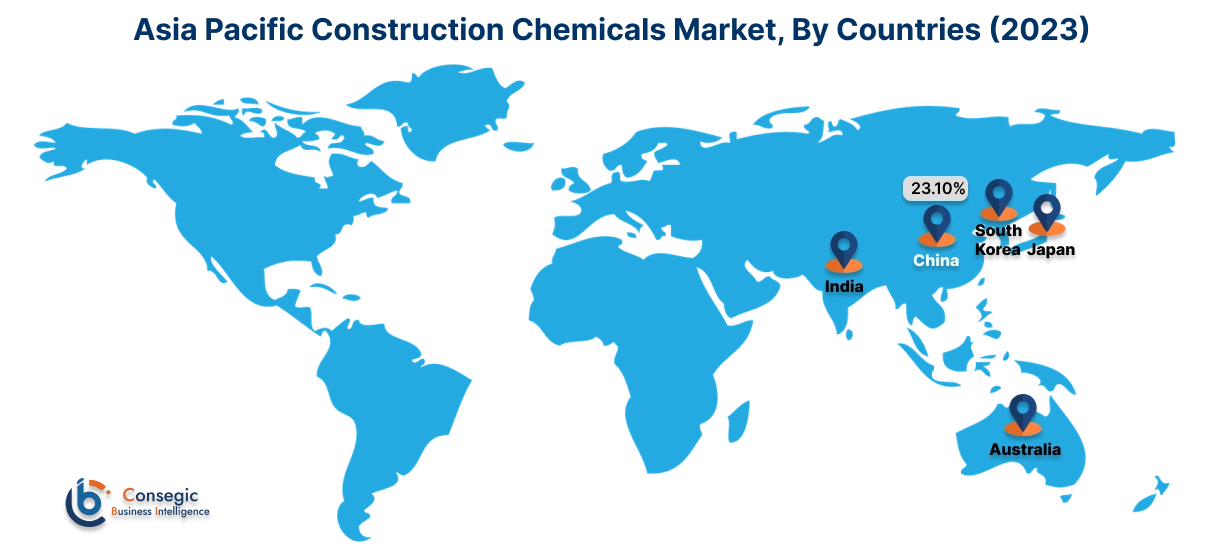
In 2023, Asia Pacific accounted for the highest market share at 38.66% and was valued at USD 17,124.66 Million and is expected to reach USD 27,966.96 Million in 2031. In Asia Pacific, China accounted for the highest market share of 23.10% during the base year of 2023. The Asia Pacific region is a rapidly growing market for construction chemicals, driven by rapid urbanization, infrastructure development, and increasing government investments in construction projects. Countries like China, India, and Southeast Asian nations are experiencing a significant rise in the construction sector, fueling the requirement for high-performance chemicals. Key applications include concrete admixtures, waterproofing solutions, sealants, and adhesives. As per the analysis, the region's diverse climatic conditions and seismic activity necessitate the use of specialized chemicals for construction to ensure the durability and longevity of structures. As the Asia Pacific region continues to develop, the market is poised for further development, driven by increasing urbanization, industrialization, and a focus on sustainable construction practices thus driving the market share.
The North American market for construction chemicals is experiencing the fastest growth with a CAGR of 6.9% over the forecast period. The North American market is a significant player in the global sector, driven by factors such as robust infrastructure development, stringent building codes, and a focus on sustainable construction. The region boasts a strong presence of leading construction chemical manufacturers, offering a wide range of products to meet diverse construction needs. Key applications include concrete admixtures, waterproofing solutions, sealants, and adhesives. The increasing emphasis on energy efficiency and green building practices has led to the development of eco-friendly chemicals that reduce the environmental impact of construction projects. Additionally, the rise in construction projects lead to the rise in utilization of these chemicals.
- For instance, according to the data published by the Construction Association, in 2023, states that the construction sector is a significant driver of the U.S. economy, with over 919,000 construction establishments operating in the first quarter of 2023.
Overall, based on the construction chemicals market analysis, as the North American construction sector continues to grow, the requirement for innovative and sustainable chemicals is expected to remain strong, thus driving the construction chemicals market trends.
The European market is, driven by stringent environmental regulations, a focus on sustainable construction, and a strong emphasis on product performance. The region has a well-established infrastructure and a diverse range of construction projects, including residential, commercial, and infrastructure developments. Key applications of these chemicals in Europe include concrete admixtures, waterproofing solutions, sealants, and adhesives. The European Union's stringent environmental regulations have led to the development of eco-friendly chemicals that minimize their impact on the environment. Based on the construction chemicals market analysis the European construction sector continues to prioritize sustainability and innovation, and the requirement for high-performance chemicals is expected to remain strong, thus leading to the construction chemicals market expansion.
The Middle East and Africa (MEA) region is witnessing a significant rise in the market, driven by rapid urbanization, infrastructure development, and increasing government investments. Key applications of these chemicals in this region include concrete admixtures, waterproofing solutions, and protective coatings. The region's diverse climate conditions, ranging from arid deserts to coastal areas, necessitate the use of high-performance chemicals to ensure the durability and longevity of buildings and infrastructure. Additionally, the growing focus on sustainable construction practices is driving the requirement for eco-friendly chemicals. As the MEA region continues to develop, the construction chemicals market trends offer opportunities for manufacturers and suppliers to cater to the region's unique needs.
The Latin American construction market is experiencing a significant rise, driven by factors such as urbanization, infrastructure development, and government initiatives to improve housing and transportation. The region's diverse climate and challenging construction conditions necessitate the use of high-performance chemicals. The market is characterized by a growing requirement for sustainable and eco-friendly chemicals, as governments and consumers prioritize environmental concerns. While the market is still developing, it offers promising opportunities for chemical manufacturers and suppliers to enter the region's growing infrastructure needs. The growing awareness of the benefits of using advanced chemicals, such as improved durability, strength, and water resistance, is contributing to the construction chemicals market growth in this region.
Top Key Players & Market Share Insights:
The global construction chemicals market is highly competitive with major players providing precise measurements between objects to the national and international markets. Key players are adopting several strategies in research and development (R&D) and product innovation to hold a strong position in the global market. Key players in the construction chemicals industry include -
- BASF SE (Germany)
- 3M (United States)
- Sika AG (Switzerland)
- Dow (United States)
- Wacker Chemie AG (Germany)
- Saint Gobain (France)
- MAPEI (India)
- Bostik (France)
- H.B. Fuller Company (United States)
- Huntsman International LCC (United States)
Recent Industry Developments :
Acquisitions:
- In October 2024, Thermax, a leading energy and environment solutions company, expanded its business portfolio by acquiring Buildtech, a prominent player. This strategic move positions Thermax to offer a comprehensive range of solutions for the construction industry, including energy-efficient building solutions and advanced construction chemicals.
- In December 2023, Arkema completed the acquisition of Arc Building Products, an Ireland-based company specializing in the production of construction adhesives and sealants. This strategic move strengthens Arkema's position in the global construction chemicals industry and expands its product portfolio.
Manufacturing Plant:
- In 2022, Sika inaugurated a new state-of-the-art concrete admixtures plant in Virginia, USA. This strategic rise will enhance Sika's ability to serve the growing demand for high-performance concrete admixtures in the North American market.
Product Launches:
- In July 2024, Saint-Gobain Construction Chemicals, through its brands Chryso and GCP, launched EnviroMix C-Clay, a new series of admixtures. These admixtures are designed to encourage the use of calcined clay-based cement in concrete production. This expansion strengthens the company's commitment to offering low-carbon concrete solutions.
- In 2022, The Euclid Chemical Company launched 3 new admixtures for concrete. These innovative products aim to improve the durability, strength, and sustainability of concrete structures.
Construction Chemicals Market Report Insights :
| Report Attributes | Report Details |
| Study Timeline | 2018-2031 |
| Market Size in 2031 | USD 71,987.04 Million |
| CAGR (2024-2031) | 6.3% |
| By Product |
|
| By End-Use |
|
| By Region |
|
| Key Players |
|
| North America | U.S. Canada Mexico |
| Europe | U.K. Germany France Spain Italy Russia Benelux Rest of Europe |
| APAC | China South Korea Japan India Australia ASEAN Rest of Asia-Pacific |
| Middle East and Africa | GCC Turkey South Africa Rest of MEA |
| LATAM | Brazil Argentina Chile Rest of LATAM |
| Report Coverage |
|
Key Questions Answered in the Report
How big is the Construction Chemicals Market? −
In 2023, the Construction Chemicals Market is USD 44,295.55 Million.
Which is the fastest-growing region in the Construction Chemicals Market? +
North America is the fastest-growing region in the Construction Chemicals Market.
What specific segmentation details are covered in the Construction Chemicals Market? +
Product Type and End-use segmentation details are covered in the Construction Chemicals Market.
Who are the major players in the Construction Chemicals Market? +
BASF SE (Germany), 3M (United States), Sika AG (Switzerland), Dow (United States), Wacker Chemie AG (Germany), Saint Gobain (France), MAPEI (India), Bostik (France), H.B. Fuller Company (United States), Huntsman International LCC (United States).
Overview
Reputation & Certifications


Our Services
- Market Intelligence & Forecasting
- Custom Research Solutions
- Market Entry Strategy
- Competitive Intelligence
- Customer Insights
- Industry Innovation Analysis
- Investment Advisory