Jump to Content
Acrylamide Tertiary Butyl Sulfonic Acid Market - Size, Share, Industry Trends, and Forecasts (2024 - 2031)
Acrylamide Tertiary Butyl Sulfonic Acid Market Size:
Acrylamide Tertiary Butyl Sulfonic Acid Market size is estimated to reach over USD 15,893.77 Million by 2031 from a value of USD 7,240.30 Million in 2023 and is projected to grow by USD 7,859.06 Million in 2024, growing at a CAGR of 10.3% from 2023 to 2031.
Acrylamide Tertiary Butyl Sulfonic Acid Market Scope & Overview:
Acrylamide Tertiary Butyl Sulfonic Acid (ATBS) is a high-performance chemical used as a monomer in various industrial and commercial applications. It is a white crystalline solid with excellent water solubility and thermal stability. Its unique chemical structure enhances its effectiveness in polymerization processes, making it a key component in the synthesis of copolymers. ATBS offers several benefits, including exceptional resistance to heat, chemical stability, and high ionic strength tolerance. These properties make it suitable for applications in extreme environmental conditions. It enhances the performance of products by improving viscosity, reducing drag, and ensuring stability under various operational parameters.
The primary applications of ATBS include water treatment, oil recovery, and personal care products. It is also widely utilized in adhesives, coatings, and textiles for improving product performance and durability. End-use industries for ATBS include oil and gas, water treatment, construction, and personal care. Its versatility and effectiveness in diverse applications position it as a critical material across multiple industrial sectors.
How is AI Impacting the Acrylamide Tertiary Butyl Sulfonic Acid Market?
AI is influencing the Acrylamide Tertiary Butyl Sulfonic Acid (ATBS) market by optimizing its production and expanding its applications. AI-powered analytics are enhancing manufacturing efficiency, improving yields, and ensuring product consistency for ATBS. This includes predictive maintenance of equipment and real-time process optimization. Furthermore, AI accelerates research and development for new polymers and formulations utilizing ATBS, particularly in demanding sectors like enhanced oil recovery, water treatment, and high-performance coatings, where its unique properties are crucial. By analyzing vast datasets, AI helps identify novel applications and optimize existing ones, driving demand for ATBS by offering superior performance and more sustainable solutions.

Acrylamide Tertiary Butyl Sulfonic Acid Market Dynamics - (DRO) :
Key Drivers:
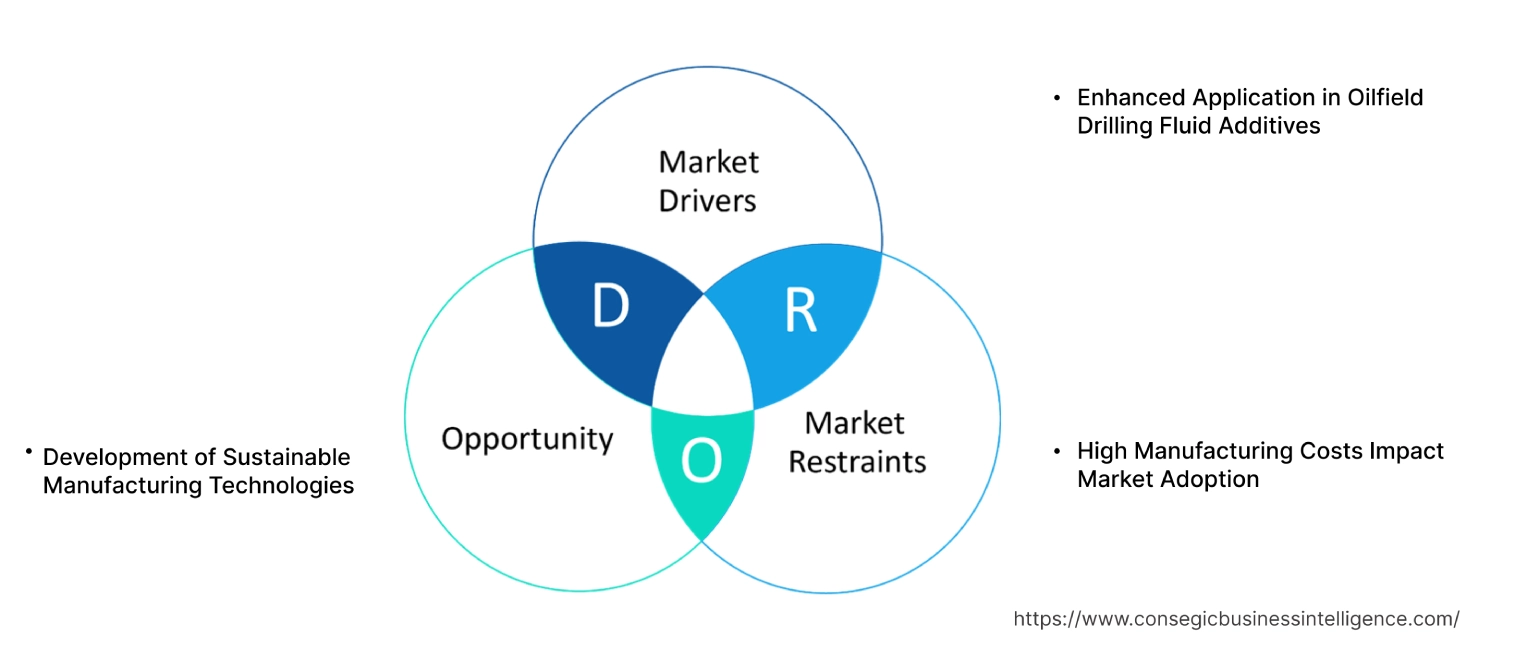
Enhanced Application in Oilfield Drilling Fluid Additives
The use of Acrylamide Tertiary Butyl Sulfonic Acid (ATBS) as a vital component in oilfield drilling fluid additives has surged due to its superior properties. ATBS improves the viscosity and thermal stability of drilling fluids, enabling efficient drilling operations in high-temperature and high-pressure environments. Its excellent resistance to salt and other contaminants enhances the performance of drilling fluids, reducing the risk of wellbore instability. For instance, advanced drilling projects in offshore oilfields have increasingly incorporated ATBS-based additives to optimize drilling performance. Therefore, the growing reliance on ATBS in oilfield operations is significantly contributing to acrylamide tertiary butyl sulfonic acid market expansion.
Key Restraints :
High Manufacturing Costs Impact Market Adoption
The production of Acrylamide Tertiary Butyl Sulfonic Acid involves complex chemical processes requiring specialized equipment and high-purity raw materials, leading to elevated manufacturing costs. These costs are further exacerbated by stringent regulations governing the production and use of chemicals, necessitating compliance with safety and environmental standards. For example, manufacturers must invest in advanced purification systems and waste treatment facilities, increasing overall operational expenses. This high cost structure restricts the widespread adoption of ATBS, particularly among small-scale manufacturers, thereby hindering acrylamide tertiary butyl sulfonic acid market growth.
Future Opportunities :
Development of Sustainable Manufacturing Technologies
The future of the Acrylamide Tertiary Butyl Sulfonic Acid market lies in the development of sustainable and cost-effective manufacturing technologies. Innovations such as bio-based synthesis processes or energy-efficient production techniques are expected to reduce environmental impact and lower production costs. For instance, research initiatives exploring enzymatic pathways for ATBS production have shown potential to minimize chemical waste and energy consumption. As industries increasingly prioritize sustainability, these advancements are anticipated to drive trend for eco-friendly ATBS solutions. Therefore, the adoption of sustainable manufacturing practices presents a significant opportunity for acrylamide tertiary butyl sulfonic acid market growth in the coming years.
Acrylamide Tertiary Butyl Sulfonic Acid Market Segmental Analysis :
By Type:
Based on type, the market is segmented into powder and liquid.
The powder segment accounted for the largest revenue in acrylamide tertiary butyl sulfonic acid market share in 2023.
- The powder form offers ease of transportation, handling, and storage compared to the liquid form.
- It is widely used in industries like oil & gas and water treatment due to its longer shelf life and stable properties.
- The powder type is preferred in Enhanced Oil Recovery (EOR) and coatings due to its compatibility and effectiveness in formulations.
- Its adaptability across various applications contributes significantly to its dominance in the market.
- Therefore, according to acrylamide tertiary butyl sulfonic acid market analysis, the preference for powder form across multiple industrial applications drives its acrylamide tertiary butyl sulfonic acid market share, contributing to its largest revenue position.
The liquid segment is anticipated to register the fastest CAGR during the forecast period.
- The liquid form is gaining traction due to its ready-to-use nature, eliminating the need for pre-mixing.
- It is particularly suitable for high-speed manufacturing processes in textiles and adhesives.
- Liquid formulations exhibit better dispersion and reactivity, especially in water and wastewater treatment applications.
- Rising trend for efficiency and reduced processing times fosters the adoption of liquid forms.
- Thus, according to acrylamide tertiary butyl sulfonic acid market analysis, the rapid acceptance of liquid formulations across industries is expected to accelerate its growth rate in the market.
By Function:
Based on function, the market is segmented into thickening agent, crosslinking agent, stabilizing agent, and other functions.
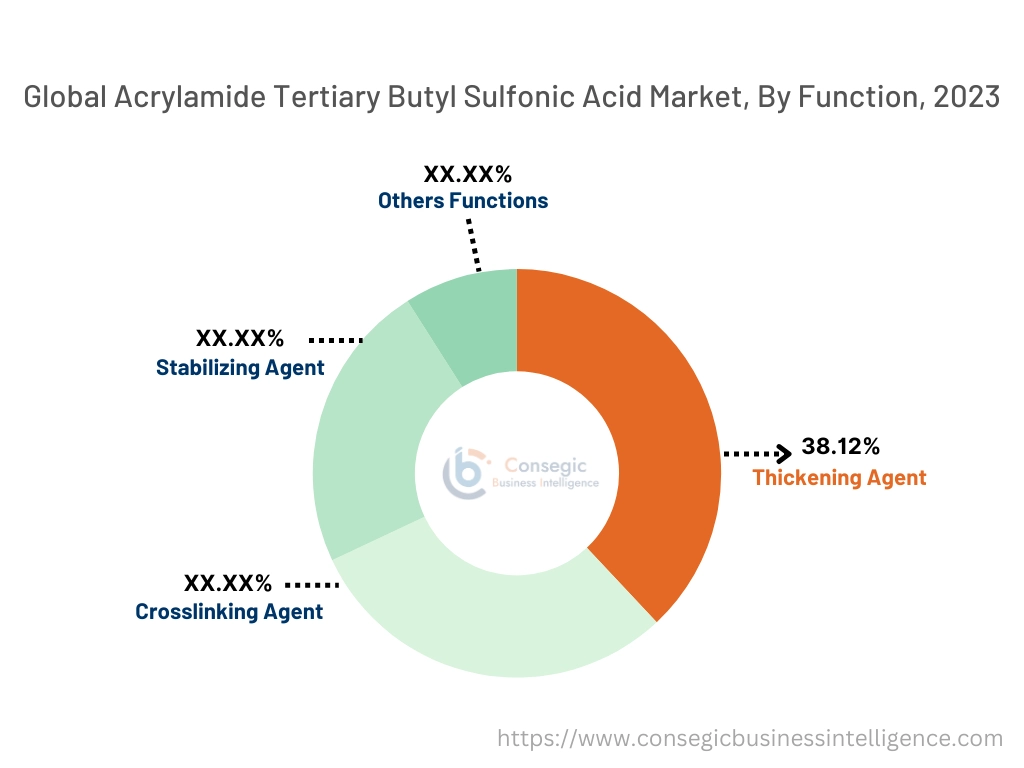
The thickening agent segment accounted for the largest revenue share of 38.12% in 2023.
- Acrylamide tertiary butyl sulfonic acid as a thickening agent enhances viscosity in oil recovery and paint formulations.
- It is extensively used in water treatment processes for its ability to modify fluid properties effectively.
- The product is valued for its compatibility with various chemical systems, improving operational efficiency.
- Increasing acrylamide tertiary butyl sulfonic acid market trend for customized viscosity solutions in coatings and adhesives bolsters its adoption.
- Therefore, according to market analysis, its versatility and critical role in modifying fluid dynamics ensure its prominence in the market.
The crosslinking agent segment is anticipated to register the fastest CAGR during the forecast period.
- Crosslinking agents enhance the durability, strength, and performance of polymers in applications like paints, coatings, and textiles.
- The segment benefits from innovations in polymer chemistry, enabling advanced functionalities.
- Growing applications in adhesives and advanced coatings drive the acrylamide tertiary butyl sulfonic acid market trend for crosslinking capabilities.
- The ability to create robust, high-performance materials aligns with industrial requirements.
- Thus, according to market analysis, the increasing need for durable, high-performance materials drives the growth of crosslinking agents in the market.
By Production Process:
Based on the production process, the market is segmented into chemical synthesis and bio-based synthesis.
The chemical synthesis segment accounted for the largest revenue share in 2023.
- Chemical synthesis is the traditional and well-established process for producing acrylamide tertiary butyl sulfonic acid.
- The process is cost-effective and supports large-scale production, meeting industrial trend efficiently.
- It offers consistent quality and high purity, making it suitable for critical applications like water treatment.
- Wide adoption in oil & gas and coatings industries reinforces its market dominance.
- Therefore, according to market analysis, the reliability and scalability of chemical synthesis underpin its stronghold in the market.
The bio-based synthesis segment is anticipated to register the fastest CAGR during the forecast period.
- Bio-based synthesis leverages renewable feedstocks, aligning with sustainability trends and regulatory compliance.
- It addresses growing consumer and industrial preferences for environmentally friendly products.
- Technological advancements are making bio-based processes more cost-competitive and efficient.
- Adoption in green chemistry applications in adhesives, coatings, and textiles is increasing.
- Thus, according to market analysis, the shift towards sustainable and eco-friendly solutions accelerates the growth of bio-based synthesis in the market.
By End-Use Industry:
Based on end-use industry, the market is segmented into oil & gas, water & wastewater treatment, paints & coatings, personal care, textiles, and other industries.
The oil & gas industry segment accounted for the largest revenue share in 2023.
- Acrylamide tertiary butyl sulfonic acid is integral to Enhanced Oil Recovery (EOR) for improving extraction efficiency.
- Its role in controlling fluid viscosity and stabilizing drilling operations enhances performance.
- The oil & gas sector's dependency on advanced chemical solutions drives consistent trend.
- Ongoing exploration and production activities globally contribute to its adoption.
- Therefore, according to market analysis, the critical importance of the product in optimizing oil recovery solidifies its dominance in the market.
The water & wastewater treatment segment is anticipated to register the fastest CAGR during the forecast period.
- Increasing focus on water quality management elevates the trend for chemical solutions.
- Acrylamide tertiary butyl sulfonic acid is employed for flocculation, coagulation, and viscosity control.
- Urbanization and industrialization propel the need for efficient wastewater management technologies.
- Regulatory mandates on water treatment and conservation bolster market growth.
- Thus, according to market analysis, the rising urgency for sustainable water management solutions supports the rapid expansion of this segment.
Regional Analysis:
The regional segment includes North America, Europe, Asia Pacific, Middle East and Africa, and Latin America.
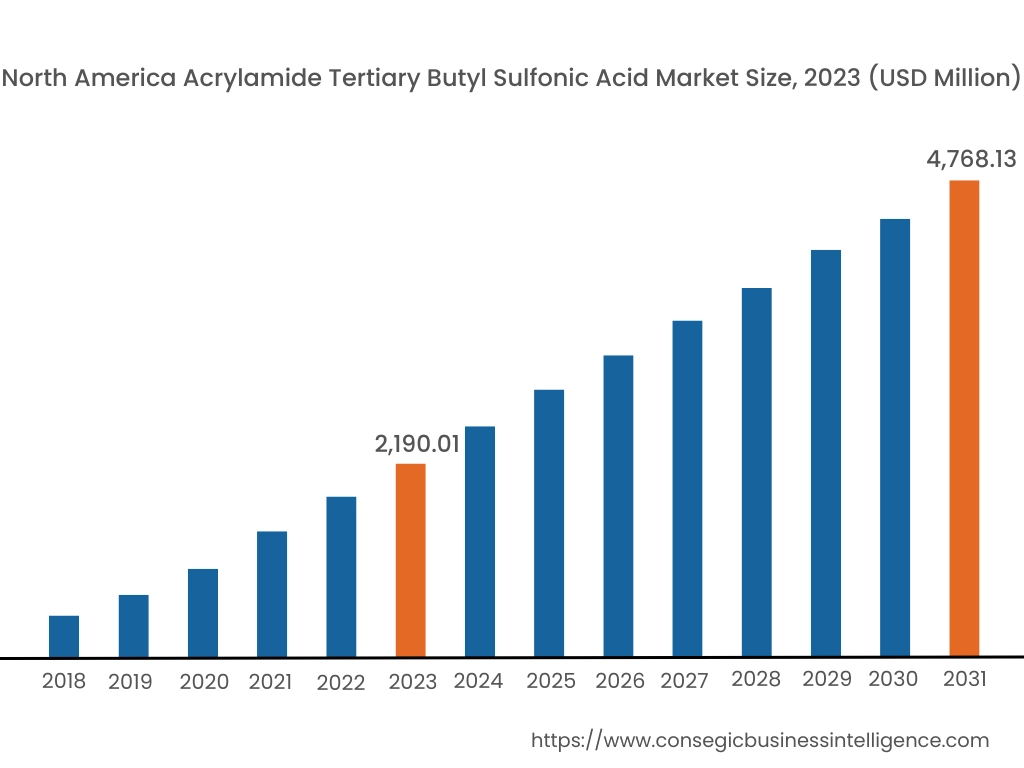
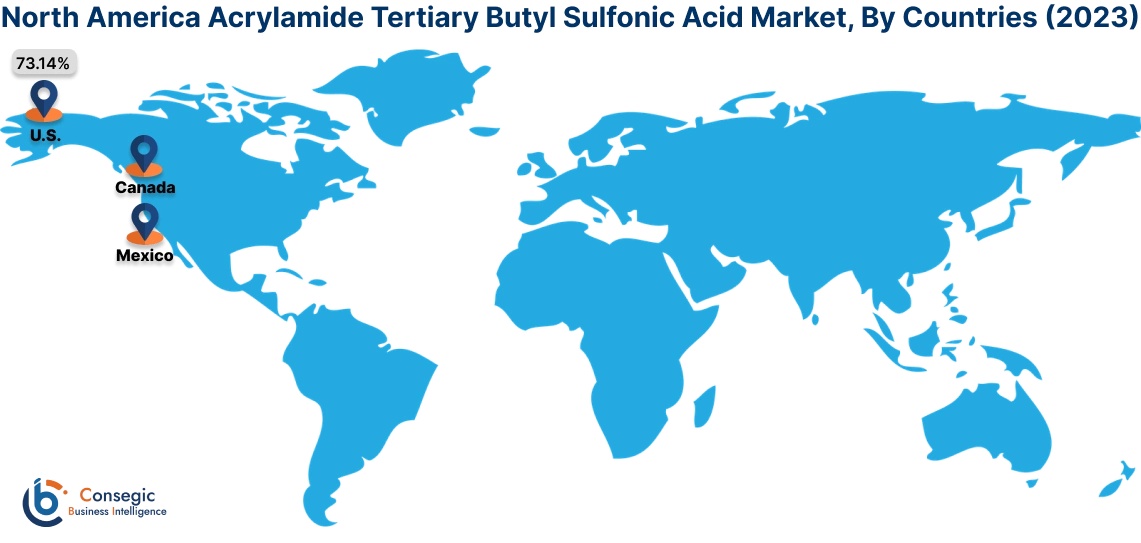
In 2023, North was valued at USD 2,190.01 Million and is expected to reach USD 4,768.13 Million in 2031. In North America, the U.S. accounted for the highest share of 73.14 % during the base year of 2023. In North America, the acrylamide tertiary butyl sulfonic acid (ATBS) market demand is supported by significant need from the oil and gas industry, where ATBS is used in enhanced oil recovery operations. The United States is a major consumer, benefiting from a robust chemical manufacturing base and increasing applications in water treatment and industrial processes. Strict environmental regulations and a focus on chemical sustainability further influence market growth, prompting increased adoption of ATBS in green technologies.
In Asia Pacific, the market is experiencing the fastest growth with a CAGR of 10.6% over the forecast period. Asia-Pacific holds the largest share of the acrylamide tertiary butyl sulfonic acid industry. China and India are key consumers due to their growing industrial sectors, particularly in water treatment, textile, and oil recovery. The region’s increasing urbanization and industrialization push acrylamide tertiary butyl sulfonic acid market demand for chemicals used in water purification and oilfield applications. Competitive pricing of raw materials and favorable government policies encourage local production, which strengthens the market in this region. Additionally, the region is seeing a rise in demand for ATBS in agricultural chemicals and detergents.
Europe exhibits steady demand for acrylamide tertiary butyl sulfonic acid, primarily in the water treatment, oil and gas, and textile industries. The region's strong focus on sustainability and environmental protection drives demand for eco-friendly alternatives like ATBS in industrial applications. Countries like Germany, France, and the United Kingdom are major contributors to the market, with increasing regulations around wastewater treatment pushing the use of ATBS-based solutions. The need for efficient water management systems and the development of green chemical processes are key market influences.
The Middle East and Africa market for acrylamide tertiary butyl sulfonic acid is expanding, driven by the region’s oil and gas industry. ATBS plays a critical role in oilfield applications, particularly for enhancing oil recovery in regions like Saudi Arabia and the UAE. As these countries focus on diversifying their economies and investing in water treatment infrastructure, the demand for ATBS in industrial water management solutions is increasing. However, challenges like the limited presence of production facilities and high raw material costs may impede market growth in certain areas.
In Latin America, countries such as Brazil and Mexico are showing increasing interest in acrylamide tertiary butyl sulfonic acid, mainly for its applications in oil recovery and water treatment. The region’s expanding oil and gas industry is a major factor in boosting market demand. However, challenges such as political instability and fluctuating raw material prices affect market performance. Still, ongoing efforts to enhance water management systems in the region create acrylamide tertiary butyl sulfonic acid market opportunities for applications, particularly in industrial and agricultural sectors.
Top Key Players and Market Share Insights:
The Global Acrylamide Tertiary Butyl Sulfonic Acid Market is highly competitive with major players providing FWA to the national and international markets. Key players are adopting several strategies in research and development (R&D), product innovation, and end-user launches to hold a strong position in the Global Acrylamide Tertiary Butyl Sulfonic Acid Market. Key players in the Acrylamide Tertiary Butyl Sulfonic Acid market include-
- BASF SE (Germany)
- The Dow Chemical Company (United States)
- Kraton Polymers (United States)
- Wuhan Yimin Chemical Co., Ltd. (China)
- Zhejiang Kangtai Chemical Co., Ltd. (China)
- Evonik Industries AG (Germany)
- Mitsubishi Chemical Corporation (Japan)
- Arkema S.A. (France)
- INEOS Group (Switzerland)
- LG Chem Ltd. (South Korea)
Acrylamide Tertiary Butyl Sulfonic Acid Market Report Insights :
| Report Attributes | Report Details |
| Study Timeline | 2018-2031 |
| Market Size in 2031 | USD 15,893.77 Million |
| CAGR (2024-2031) | 10.3 % |
| By Type |
|
| By Function |
|
| By Production Process |
|
| By End-Use Industry |
|
| By Region |
|
| Key Players |
|
| North America | U.S. Canada Mexico |
| Europe | U.K. Germany France Spain Italy Russia Benelux Rest of Europe |
| APAC | China South Korea Japan India Australia ASEAN Rest of Asia-Pacific |
| Middle East and Africa | GCC Turkey South Africa Rest of MEA |
| LATAM | Brazil Argentina Chile Rest of LATAM |
| Report Coverage |
|
Key Questions Answered in the Report
How big is the Acrylamide Tertiary Butyl Sulfonic Acid Market? −
In 2023, the Acrylamide Tertiary Butyl Sulfonic Acid Market was USD 7,240.30 million.
What will be the potential market valuation for the Acrylamide Tertiary Butyl Sulfonic Acid Market by 2031? +
In 2031, the market size of Acrylamide Tertiary Butyl Sulfonic Acid Market is expected to reach USD 15,893.77 million.
What are the segments covered in the Acrylamide Tertiary Butyl Sulfonic Acid Market report? +
The type, function, production process, and end-user industry are the segments covered in this report.
Who are the major players in the Acrylamide Tertiary Butyl Sulfonic Acid Market? +
BASF SE (Germany), The Dow Chemical Company (United States), Evonik Industries AG (Germany), Mitsubishi Chemical Corporation (Japan), Arkema S.A. (France), INEOS Group (Switzerland), LG Chem Ltd. (South Korea), Kraton Polymers (United States), Wuhan Yimin Chemical Co., Ltd. (China), Zhejiang Kangtai Chemical Co., Ltd. (China) are the major players in the Acrylamide Tertiary Butyl Sulfonic Acid market.
Overview
Reputation & Certifications


Our Services
- Market Intelligence & Forecasting
- Custom Research Solutions
- Market Entry Strategy
- Competitive Intelligence
- Customer Insights
- Industry Innovation Analysis
- Investment Advisory