Jump to Content
ModelOps Market Size & Industry Share - Growth Trends & Forecasts (2026 - 2034)
ModelOps Market Introduction :
The ModelOps Market is projected to grow from US$ 6.93B in 2025 to US$ 9.13B in 2026, and is expected to surpass US$ 109.37B by 2034, expanding at a CAGR of 31.80% between 2026 and 2034, according to a recent report from Consegic Business Intelligence.
What is driving demand for ModelOps platforms?
The rising adoption of AI and machine learning across industries is the core driver — as organizations deploy more models into production, they need a framework for continuous integration, delivery, and lifecycle management to keep those models compliant and performing.
How is the ModelOps market segmented?
By offering, it splits into platform and services (consulting, implementation/integration, and support). It's also segmented by deployment (on-premise, cloud, hybrid), enterprise type (large enterprise, SME), and end user, including BFSI, IT & telecom, healthcare, retail & e-commerce, manufacturing, and government & defense.
What challenges does the ModelOps market face?
Coordinating models built in different environments and with different tools is a persistent operational challenge, and manual processes or data silos between development and operations teams can slow deployment and updates.
ModelOps Market Definition & Overview:
ModelOps (model operationalization) focuses on the governance and lifecycle management of various operationalized AI and decision models, including machine learning, knowledge graphs, rules, and optimization models. It includes a wider range of AI models and emphasizes robust governance and lifecycle management. Moreover, modelOps provides relevant frameworks for managing and controlling the lifecycle of AI models while ensuring they adhere to established policies, regulations, and standards.
Key Regional Insights
- North America
- Held the largest market share, valued at USD 2.86 billion in 2025 and expected to reach USD 34.28 billion by 2033
- Growth driven by rising investment in AI integration across BFSI, healthcare, government & defense, and retail sectors
- Asia Pacific
- Market valued at USD 1.48 billion in 2025 and expected to reach USD 18.39 billion by 2033
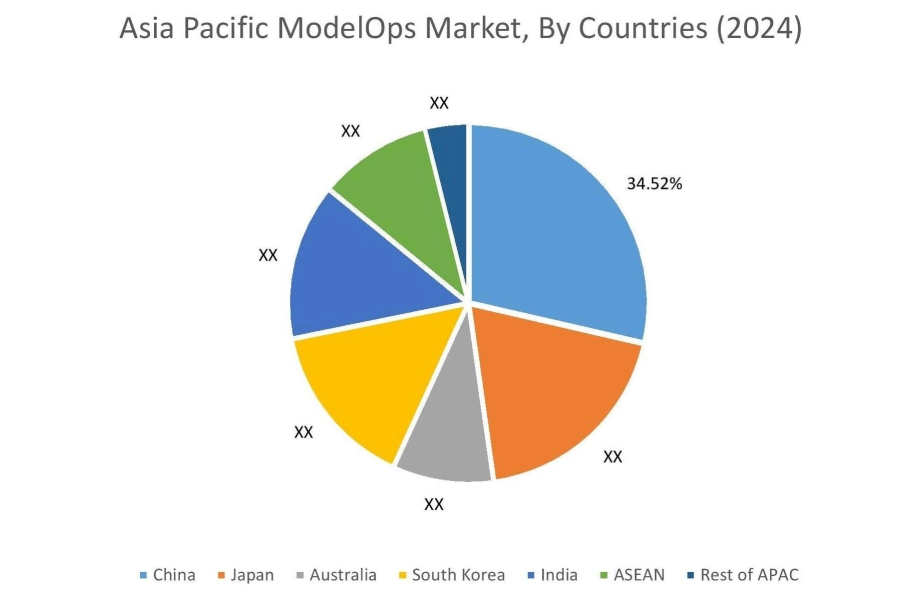
- China accounted for the maximum revenue share of 34.52%
- Growth driven by expanding IT, healthcare, and BFSI sectors and increasing e-commerce adoption of AI/ML governance tools

ModelOps Market Dynamics - (DRO) :
Key Drivers:
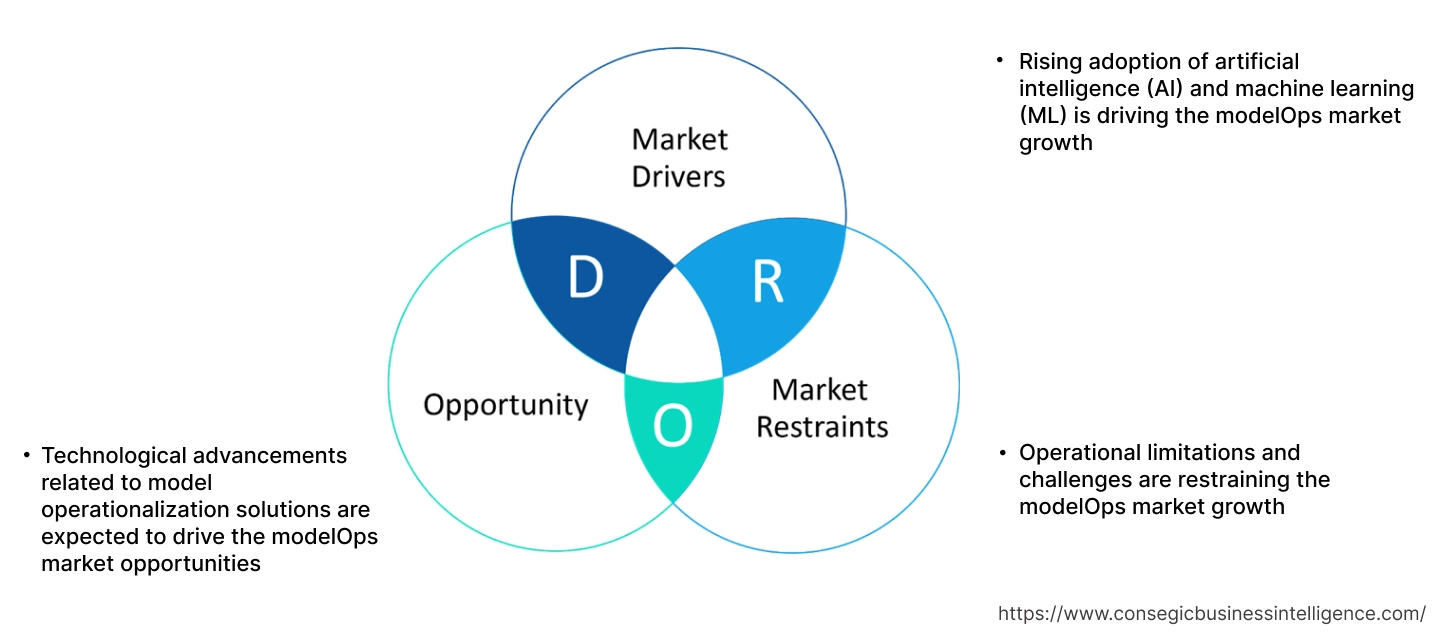
Rising adoption of artificial intelligence (AI) and machine learning (ML) is driving the modelOps market growth
There is a rising adoption of AI and ML solutions across several industries to facilitate automation and improved operational efficiency. Moreover, businesses are increasingly integrating AI and ML into their operations to gain a competitive edge, enhance efficiency, and personalize customer experiences. As AI and ML models become more prevalent across various industries, the need to effectively manage, deploy, and monitor these models in production environments becomes crucial. This is further driving the adoption of modelOps for providing the necessary framework for continuous integration, delivery, and lifecycle management of AI/ML models.
- For instance, according to Vention, a software development company, over 80% of businesses have embraced AI to a certain extent, viewing AI as a vital technology within their business organizations.
Thus, the rising adoption of AI and ML solutions, along with increasing demand for governance and lifecycle management solutions for various operationalized AI and decision models, are driving the modelOps market size.
Key Restraints :
Operational limitations and challenges are restraining the modelOps market growth
The implementation of model operationalization solutions is often associated with certain operational limitations and challenges, which are among the primary factors restraining the market. The key challenges related to the deployment of model operationalization solutions include managing the complexity of model ecosystems, ensuring governance and compliance, addressing operational bottlenecks, and automating model monitoring and maintenance.
Organizations often use a combination of models developed in different environments and using various tools. Coordinating these models and ensuring they work together smoothly is one of the major challenges. Additionally, manual processes and data silos between development and operations teams can hinder the smooth deployment and updates of models. Thus, the above operational limitations and challenges associated with the deployment of model operationalization solutions are hindering the modelOps market expansion.
Future Opportunities :
Technological advancements related to model operationalization solutions are expected to drive the modelOps market opportunities
Model operationalization solution providers are frequently investing in the development of new technologies associated with modelOps to ensure its safe and effective utilization in several industries such as BFSI, telecom & IT, retail, healthcare, government & defense, and other sectors. As a result, model operationalization solution providers are launching new solutions integrated with advanced technologies and features, thereby providing lucrative aspects for market development.
- For instance, in July 2025,ModelOp launched its new Agentic AI chat interface and end-to-end lifecycle automation tools, which are specifically developed for governing Agentic AI. This demonstrates the company’s advancement in technology while providing business enterprises with improved control for autonomous innovation.
Hence, according to the analysis, the rising technological advancements associated with model operationalization solutions are projected to boost the modelOps market opportunities during the forecast period.
ModelOps Market Report Insights :
| Report Attributes | Report Details |
| Study Timeline | 2020-2034 |
| Market Size in 2034 | US$ 109.37B |
| CAGR (2026-2034) | 31.80% |
| By Offering |
|
| By Deployment |
|
| By Enterprise Type |
|
| By End User |
|
| By Region |
|
| Key Players |
|
ModelOps Market Segmental Analysis :
By Offering:
Based on offering, the market is segmented into platform and services.
Trends in the offering:
- Increasing technological advancements associated with model operationalization platform for facilitating improvedgovernance and lifecycle management of various operationalized AI and decision models are driving the market.
- Rising utilization of model operationalization platform in BFSI, healthcare, retail, and other sectors for facilitating advanced AI governance and enhanced operational efficiency is driving the market growth.
The platform segment accounted for the largest revenue share in the modelOps market share in 2024, and it is anticipated to register a significant CAGR during the forecast period.
- ModelOps platform includes a range of tools, technologies, and best practices for deploying, monitoring, and managing AI and ML models. The platform is capable of scaling and governing AI at the enterprise level.
- Additionally, the model operationalization platform offers various benefits, including accelerated deployment, simpler onboarding, improved scalability, greater agility, enhanced visibility, reduced costs, and others.
- For instance, Teradata offers ModelOps platform in its solution offerings. The platform offers several features such asstandardized lifecycle management, automated monitoring, simplified deployment, advanced governance, and others.
- According to the modelOps market analysis, the increasing advancements associated with model operationalization platform are further driving the market.
By Deployment:
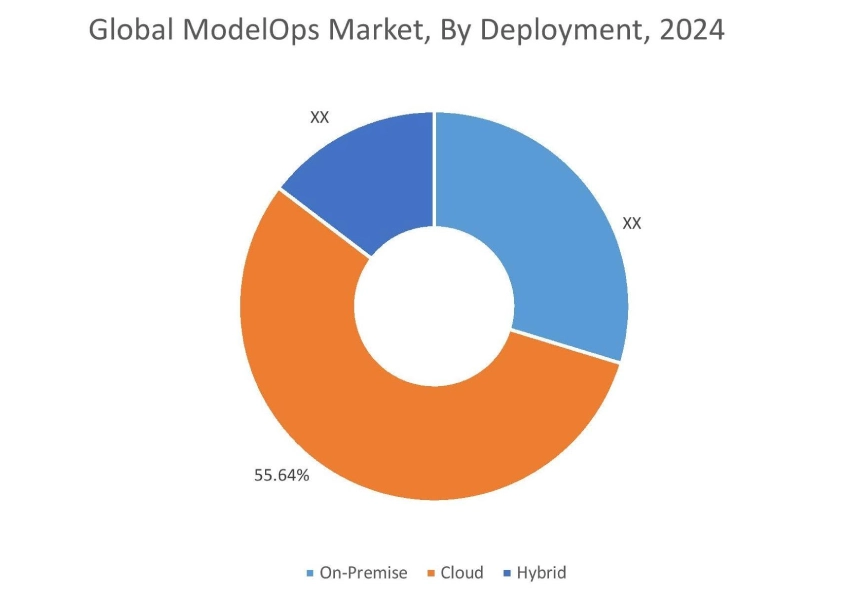
Based on deployment, the market is segmented into on-premise, cloud, and hybrid.
Trends in the deployment:
- The adoption of on-premise deployment is primarily driven by higher security and privacy, lower network bandwidth costs, and more control over server hardware.
- Factors including the ease of integration, rapid deployment, and increasing consumer preference for flexible, scalable, reliable, and cost-effective model operationalization platform are driving the cloud deployment segment.
The cloud segment accounted for the largest revenue share of 55.64% in the overall modelOps market share in 2024, and it is anticipated to register the fastest CAGR during the forecast period.
- The cloud-based deployment provides seamless collaboration along with fast and cost-effective access to model operationalization platform by multiple users, irrespective of the time and location of the user.
- Moreover, cloud-based deployment offers multiple benefits, including minimal capital expense, rapid implementation, ease of utilization and integration, higher scalability, and faster processing, among others.
- For instance, DataKitchen Inc. offers cloud-based model operationalization platform in its offerings, which is developed for simplifying and managing an organization’s end-to-end ML pipelines for seamless collaboration, training, monitoring, deployment, and governance.
- According to the market analysis, increasing advancements related to cloud-based model operationalization platform are driving the modelOps market trends.
By Enterprise Type:
Based on enterprise type, the market is segmented into large enterprise and small and medium enterprise (SME).
Trends in the enterprise type:
- Increasing trend in adoption of model operationalization platform in large enterprises for streamlining AI governance and lifecycle management, automating AI/ML model monitoring, and improving operational efficiency.
- Factors including growing investments in the development of small and medium enterprises and rising deployment of cloud-based model operationalization platform in SMEs are key aspects driving the small and medium enterprise segment.
Large enterprise segment accounted for the largest revenue in the overall market in 2024.
- Large enterprises refer to companies that have an above-average business size, perform large operations, and have high economies of scale.
- Large enterprises primarily consist of a larger workforce, generate a high amount of revenue, and have a greater competitive capacity in comparison to small and medium enterprises.
- Moreover, the model operationalization platform is primarily deployed in large enterprises for managing the entire lifecycle of AI and analytics models, ranging from development to deployment and ongoing monitoring.
- The use of model operationalization solutions in large enterprises ensures that AI and ML models are effectively integrated into business processes while driving value and maintaining compliance.
- For instance, ModelOp offers model operationalization solutions for large enterprises in its solution offerings. The company’s model operationalization solutions can assist large enterprises in scaling and governing their AI initiatives effectively.
- Therefore, the increasing adoption of model operationalization solutions in large enterprises is driving the modelOps market size.
Small and medium enterprise (SME) segment is anticipated to register the fastest CAGR during the forecast period.
- Small and medium enterprises refer to companies that maintain revenues, workforce, and assets below a certain threshold.
- SMEs often account for the majority of the businesses that are operating across the world.
- Moreover, model operationalization solutions are often used in small and medium enterprises for streamlining the deployment, monitoring, and governance of AI models.
- For instance, according to the U.S. Chamber of Commerce, the number of small businesses in the United States reached 33.2 million in 2022, representing nearly 99.9% of total businesses in the U.S.
- Thus, the rising number of small and medium enterprises is projected to drive the adoption of model operationalization platforms, in turn propelling the market during the forecast period.
By End User:
Based on the end user, the market is segmented into BFSI, IT & telecom, healthcare, retail & e-commerce, manufacturing, government & defense, and others.
Trends in the end user:
- Increasing deployment of AI/ML models in BFSI sector for crucial applications, such as risk assessment, fraud detection, customer service, and others, is driving the market demand.
- There is a rising trend towards the adoption of model operationalization solutions in healthcare industry for automating AI/ML model deployment into production for healthcare systems and facilitating centralized governance for model documentation, approvals, and audit trails.
The BFSI segment accounted for a substantial revenue in the market in 2024.
- BFSI models usually deploy AI/ML models for crucial applications such as risk assessment, fraud detection, customer service, and others, and they must ensure these models are accurate, compliant, secure, and updated.
- Model operationalization solutions are used in the BFSI sector for several applications, including automating AI/ML model deployment into production for banking systems, managing AI model lifecycle, enforcing AI governance for regulatory compliance, and others.
- For instance, according to the Federal Reserve Board, there are approximately 2,160 large commercial banks in the United States as of March 2025. These banks have consolidated assets of USD 300 million or more, with several branches in the U.S as well as other countries.
- Hence, the growing BFSI sector and rising adoption of AI solutions in BFSI firms aredriving the market growth.
The healthcare segment is anticipated to register the fastest CAGR during the forecast period.
- AI/ML models are increasingly used in the healthcare sector for several applications, including disease prediction, clinical decision support, and imaging & patient monitoring applications, among others.
- Moreover, model operationalization solutions are often used in healthcare sector for automating AI/ML model deployment into production for healthcare systems, continuous monitoring for bias, drift, and model accuracy, along with facilitating centralized governance for model documentation, approvals, and audit trails.
- For instance, ModelOp is a model operationalization solution provider that offers an AI governance solution for healthcare firms. The model operationalization solutions helps in establishing AI governance to ensure that healthcare providers can keep pace with the rapid expansion of AI use cases and maintain risk-based compliance with global, state, federal, as well as local regulations.
- Consequently, the above factors areexpected to drive the market growth during the forecast period.
Regional Analysis:
The regions covered are North America, Europe, Asia Pacific, the Middle East and Africa, and Latin America.
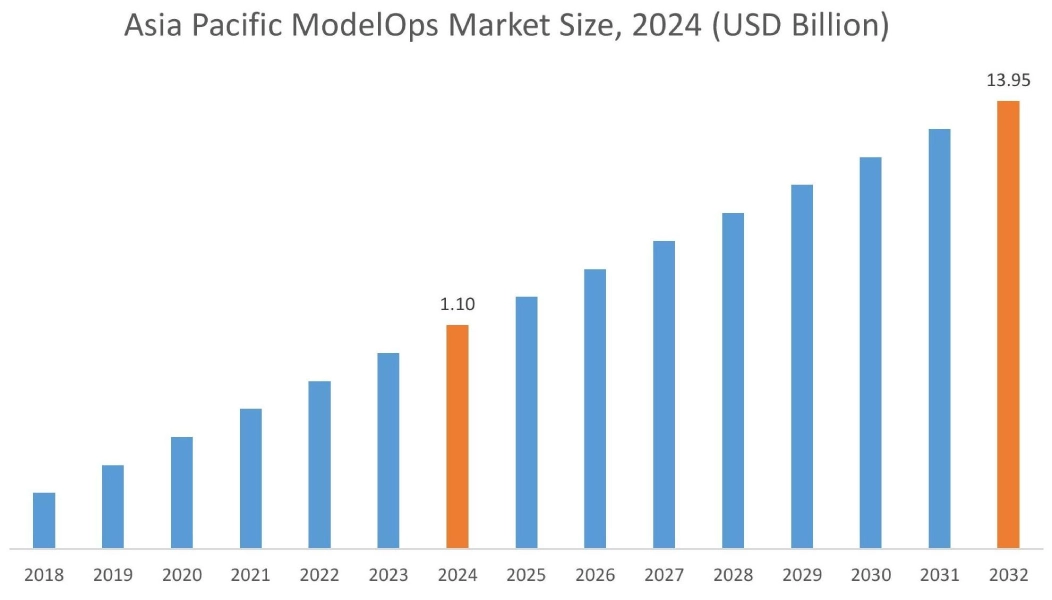
Asia Pacific region was valued at USD 1.10 Billion in 2024. Moreover, it is projected to grow by USD 1.48 Billion in 2025 and reach over USD 13.95 Billion by 2032. Out of this, China accounted for the maximum revenue share of 34.52%. As per the modelOps market analysis, the adoption of model operationalization solutions in the Asia-Pacific region is primarily driven by the growing IT, healthcare, and BFSI sectors, among others. Additionally, the growing retail & e-commerce sector and increasing adoption of model operationalization solutions among retail enterprises for managing, deploying, monitoring, and governing AI/ML models used in various business processes are further accelerating the modelOps market expansion.
- For instance, according to the India Brand Equity Foundation, the e-commerce sector in India was valued at USD 93 billion in 2023, and it is projected to grow to USD 550 billion by 2035. The above factors are further driving the market in the Asia-Pacific region.
North America is estimated to reach over USD 26.01 Billion by 2032 from a value of USD 2.12 Billion in 2024 and is projected to grow by USD 2.86 Billion in 2025. In North America, the growth of the modelOps industry is driven by growing investments for AI integration in BFSI, healthcare, government & defense, retail, and other sectors. Moreover, the increasing need for AI solutions in BFSI sector for streamlining banking operations and increasing operational efficiency is further contributing to the modelOps market demand.
- For instance, in July 2022, Citi Bank launched its new Citi Commercial Bank in Canada, as a part of the company’s global extension plan. Citi Commercial Bank offers a wide range of institutional solutions and products to meet the evolving needs of corporates. The above factors are expected to propel the modelOps market trends in North America during the forecast period.
Meanwhile, according to the regional analysis, factors including growing manufacturing, BFSI, and healthcare sectors, combined with the increasing adoption of AI/ML solutions among business enterprises, are driving the modelOps market demand in Europe. Furthermore, according to the market analysis, the market demand in Latin America, Middle East, and African regions is expected to grow at a considerable rate due to factors such as rising development of retail & e-commerce businesses, increasing investments in healthcare facilities, prevalence of several initiatives for AI adoption among business enterprises, and other related factors.
Top Key Players & Market Share Insights:
The global modelOps market is highly competitive with major players providing products to the national and international markets. Key players are adopting several strategies in research and development (R&D), product innovation, and end-user launches to hold a strong position in the modelOps market. Key players in the modelOps industry include-
Recent Industry Developments :
Product Launch:
- In May 2024, ModelOp released its new ModelOp Version 3.3. This new AI governance software enables enterprise leaders to score AI risks and constantly govern AI initiatives. The solution also offers real-time visibility into all AI initiatives, including generative AI, third-party, in-house, and embedded AI systems, along with their risks across the entire enterprise.
Key Questions Answered in the Report
How big will the modelops market be by 2033? −
Consegic Business Intelligence expects the market to grow from USD 6,930.00 Million in 2025 to USD 82,981.28 Million by 2033, a CAGR of 31.80% over the 2026-2033 forecast period.
Which region currently leads the market? +
North America currently holds the largest share of the market, supported by its mature infrastructure, large enterprise base, and early adoption of advanced technologies.
Where is growth happening fastest? +
Asia Pacific is on track for the fastest CAGR through 2033, largely because expanding IT, healthcare, and BFSI sectors are adopting AI/ML models faster than they can govern them without a dedicated platform.
Who are the major players? +
IBM (USA), TIBCO (USA), Teradata (USA), ModelOp (USA), and SAS Institute Inc. (USA) are among the more established names, alongside a broader field of regional and specialized manufacturers.
What types of ModelOps does the market cover? +
The market is segmented by offering, covering Platform, Services, Consulting Services, Implementation/Integration Services, and 1 other categories.
Overview
Reputation & Certifications


Our Services
- Market Intelligence & Forecasting
- Custom Research Solutions
- Market Entry Strategy
- Competitive Intelligence
- Customer Insights
- Industry Innovation Analysis
- Investment Advisory